Andreas Ketels
Artist and founder of Glowbus®
A beautiful fire does not begin with the match, but with the wood. For a fire pit, it is best to choose dry, untreated hardwood such as ash, beech or well-seasoned oak. Birch is ideal if you want a lively flame more quickly, with plenty of atmosphere and less fuss when lighting it. Softwood such as spruce, fir or pine is best used mainly as kindling. That way, you get more heat, less smoke and a calmer flame pattern. Always use it on a stable, heat-resistant surface and take local rules for open fires into account. If, after this advice, you would also like to look at suitable fire pits in the online shop, pay attention to size, stability and ventilation.
- Best all-round choice: ash and beech
- For quick lighting and a light, lively flame: birch
- For kindling: dry spruce, fir or pine
- Always avoid wet, painted or treated wood
Choose dry, untreated wood first
If you remember only one rule, let it be this: use dry wood. In a fire pit, fire bowl or fire sculpture, you notice the difference straight away. Wet wood hisses, smokes, smells heavier and gives off less heat because part of the energy first goes into evaporating moisture. Good firewood ideally has a moisture content of about 15 to 20 per cent. Above 20 per cent, the fire becomes harder to manage, smokier and less efficient. Wood that is much drier than 15 per cent can burn perfectly well, but it will often burn up a little faster.
You can often recognise dry wood by small cracks at the end grain, looser bark and a lighter weight. If you want to be sure, use a moisture meter and measure on the freshly split inside of a log, not just on the outside. That is well worth it with an open fire, because dry wood not only gives more comfort, but also sends less smoke towards neighbours and the patio. Also always choose natural, untreated wood. Anything that is painted, varnished, glued or pressure-treated has no place in a fire pit.
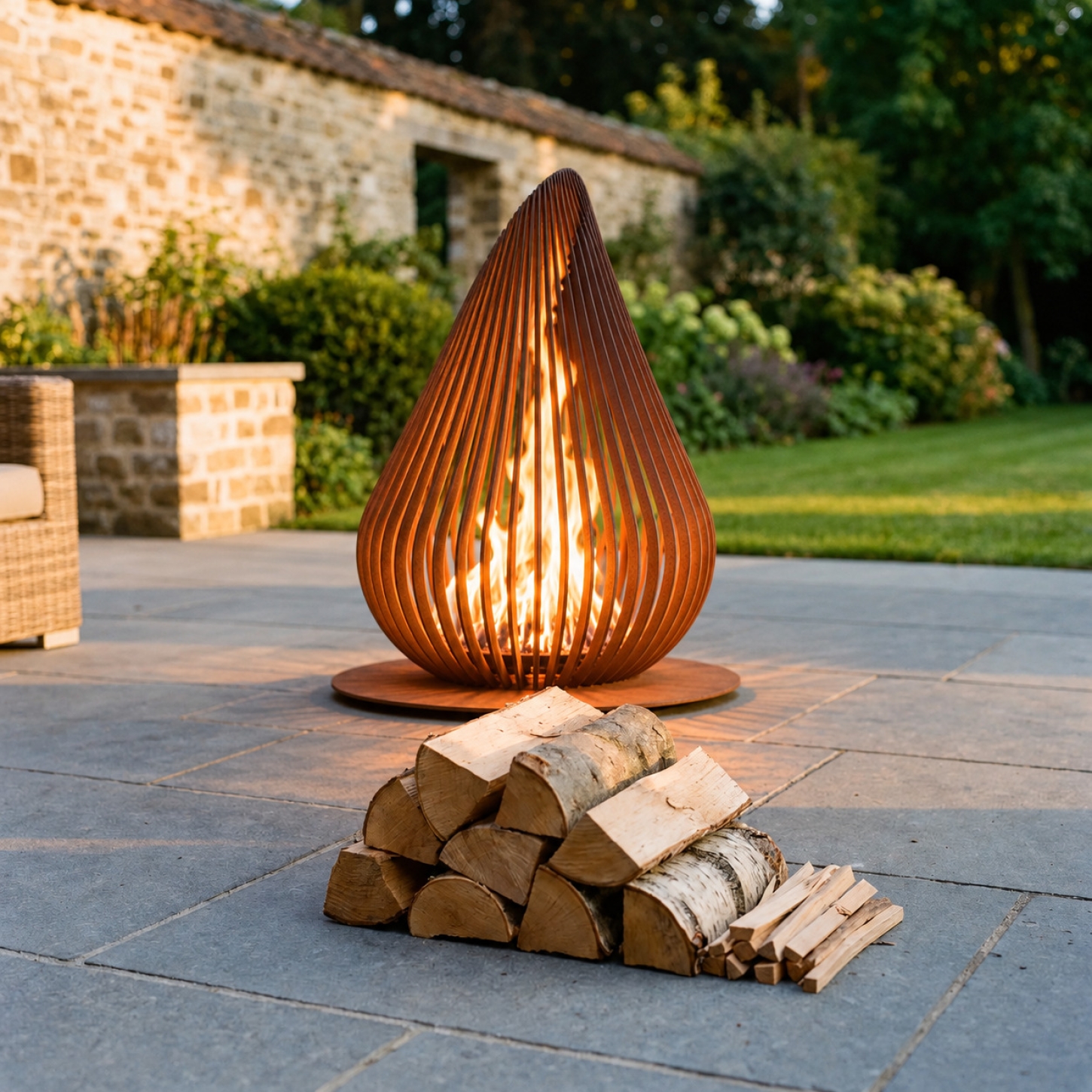
The best types of wood for a fire pit
Not every type of wood burns in the same way. The best choice depends on what you want: a long burn, instant atmosphere or easy lighting.
| Type of wood | Burn time | Flame character | Smoke and sparks | Best use |
|---|---|---|---|---|
| Ash and beech | Long | Calm and warm | Little smoke when dry | Main fuel for long evenings |
| Oak | Very long | Deep and powerful | Can smoke more if it is not properly dry | Long burning with fully seasoned wood |
| Birch | Medium | Bright and lively | Relatively clean, burns up faster | Atmosphere and easy lighting |
| Spruce, fir and pine | Short | Fast and fierce | More sparks and resin | Kindling |
For long evenings: ash, beech or well-seasoned oak
If you want to enjoy a longer fire at ease, ash or beech are usually the right choice. These woods are dense in structure, give off plenty of heat and burn evenly. So you need to top up less often. Oak also burns for a long time, but only if it has been dried really well. If not, you will more quickly get more smoke and a less steady burn. That is why ash and beech are the safest all-round choice for many fire pits. If you are still deciding between a fire pit or design fire pit, it is wise to look at flame character and ease of use as well.
For instant atmosphere: birch
Birch is popular because it catches easily and gives a bright, lively fire. Ideal for a shorter evening, a spontaneous moment on the patio or when you do not want to spend a long time fiddling with the fire first. The downside is that birch burns up faster than heavier hardwood. So you get lots of atmosphere, but less burn time.
For lighting: use softwood consciously
Spruce, fir and pine are excellent for getting a fire going. They catch quickly and help you build your first heat. As the main fuel, they are less suitable for a fire pit because they burn up faster and often throw more sparks. That is especially noticeable with resin-rich softwood. So use them in smaller amounts and then switch to harder, more steadily burning wood.
Which wood is best avoided
Some wood seems convenient because it is to hand, but it is unsuitable or even unsafe to burn. In an open fire, smoke, smell and sparks are released directly. That is why it is even more important to be strict about what you do and do not use.
- Painted, varnished or pressure-treated wood
- Chipboard, MDF, plywood and other glued boards
- Pallets or reclaimed timber with unknown treatment
- Garden timber, fence panels and pressure-treated planks
- Wet garden waste, leaves, cardboard and paper as the main fuel
The reason is simple: these materials can cause harmful substances, lots of smoke, unpleasant smells and extra sparks. On top of that, they disrupt clean combustion and often leave behind more polluting ash residue. If you want a beautiful fire, choose pure wood and nothing else.
How to get a better fire with less smoke
An open fire always smokes a little, but you can greatly reduce the amount. That is not only down to the type of wood, but also to how you burn it. Large, unsplit logs often smother a small fire rather than feeding it. For most fire pits, smaller to medium-sized split logs are easier to use. Think of lengths of about 25 to 30 centimetres, depending on the size of your fire pit.
- Start with small, dry wood, not heavy logs.
- Place the larger logs at the bottom and the finer wood on top.
- Light the fire at the top, so it burns downwards steadily.
- Only add new wood once there is already a stable base of flames and embers.
This way of lighting generally gives a cleaner start and less smoke. Also leave enough air between the logs, because fire needs oxygen to burn brightly and warmly. So do not fill the fire pit all at once. A good fire grows in layers. You can see that not only in the smoke, but also in the rhythm of the flame: calmer, warmer and more pleasant to sit around together. For anyone who finds making a fire with children safely important, this calm build-up helps even more.
Store wood so it stays ready to burn
Good wood can still burn badly if you store it the wrong way. So never place firewood directly on the ground, but on a pallet, rack or other raised surface. That allows air to pass underneath and moisture is less likely to be drawn into the wood. Cover only the top against rain and leave the sides open for ventilation. Wood that is fully wrapped dries less well and can even become damp again.
The drying time depends on the type of wood. Lighter wood is often ready to burn more quickly, while oak can take much longer. As a rough guide, allow at least six months for faster-drying types and rather one to two years for heavier hardwood such as oak. Kiln-dried wood is ready to use straight away. In the Belgian and Dutch outdoor climate, wood takes up moisture again fairly quickly, so preferably only bring outside what you will actually use that evening.
Frequently asked questions about wood for a fire pit
Can I burn spruce wood in a fire pit?
Yes, but preferably use small amounts to get the fire going. Spruce burns quickly and fiercely, but often throws more sparks and is therefore less suitable as the main fuel for a long, calm evening.
Which wood gives off the least smoke?
Fully dry, untreated hardwood usually gives off the least smoke. Ash and beech are often the most pleasant choices. A lot of smoke, incidentally, is caused not only by the type of wood, but above all by moisture and too little air in the fire.
How dry should wood be for a fire pit?
Aim for a moisture content of about 15 to 20 per cent. Preferably measure on a freshly split inside face of the log. That gives a more reliable picture than the outside.
Which type of wood burns the longest?
Dense hardwoods burn the longest. Think of oak, beech and ash. Oak really does need enough drying time, otherwise you will get smoke more quickly and a less attractive burn.
Can I use pallets or reclaimed timber?
That is not recommended. You often do not know how the wood has been treated, and it may contain glues, coatings or metal parts. For an open fire, untreated firewood is always the safe choice.
How large should the logs be for a fire pit?
For most fire pits, split logs of about 25 to 30 centimetres work well. They catch more quickly, give better air circulation and are easier to top up in controlled amounts.


Experience Glowbus®
in your area
To discover the Glowbus® collection in real life, you can contact an official dealer in your area.